Search Now...
Search

Feature flags are powerful control mechanisms — but without proper security, they can become critical vulnerabilities. This article explores best practices for securing feature flag systems, including strict RBAC enforcement, server-side authorization, secure token management, change approval workflows, immutable audit logging, and compliance alignment with frameworks like National Institute of Standards and Technology and OWASP. Learn how to treat feature flags as Tier-1 infrastructure and protect your release process from accidental or malicious misuse.

The worldwide supply chain is a complex web of interconnected networks, supported by a range of global supply chain services that keep goods flowing across bord...

With the technology now in place, organisations can finally transition from passive monitoring to the long-held ideal of active threat neutralisation.
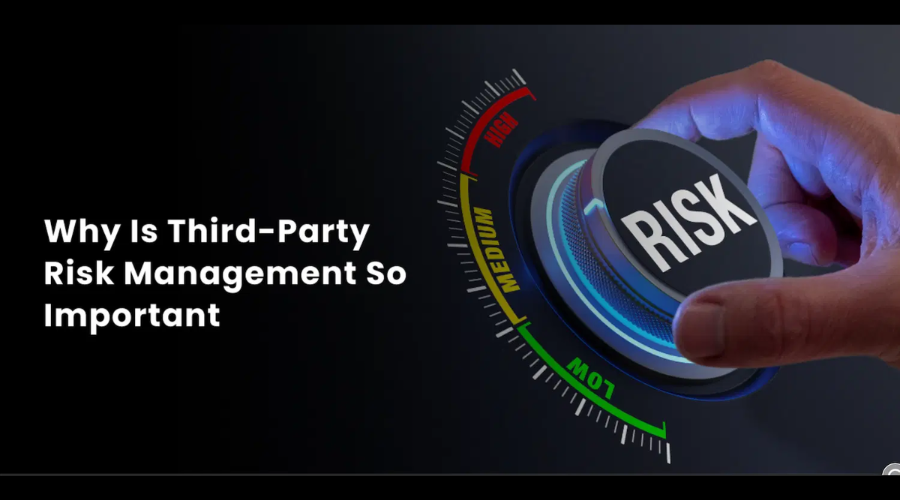
Why is third party risk management so important? Discover its critical role in safeguarding data, ensuring compliance, and minimizing operational risks.

Online gaming leader Rush Street Interactive (RSI) chose Teleport to eliminate security friction across its multi-cloud infrastructure. Discover how Teleport delivered 3x faster access provisioning, eliminated inbound SSH ports via reverse tunnels, and secured SOC 2 Type 2 compliance by leveraging short-lived credentials for human and machine identities.

IBM Instana needed to secure access to its sensitive cloud infrastructure while boosting developer agility. Discover why they chose Teleport to replace VPNs and shared credentials, simplifying compliance audits (SOC 2, FedRAMP) and eliminating management overhead across their rapidly scaling, multi-cloud environment.

Start your DHI trial strong! This guide shows how Docker Hardened Images move you to near-zero CVEs in 3 steps. We compared official Node.js to DHI and found a 100% vulnerability elimination (25 CVEs to 0), a 90% package reduction, and 41% smaller images, validating the compliance benefits with Docker Scout and SBOMs.

The cost of security shouldn't limit protection. Docker now offers unlimited access to its Hardened Images (DHI) catalog via an affordable subscription. Get near-zero CVEs, a 95% smaller attack surface, and SRLabs-validated security with SBOM/VEX support for every team, from ML workloads to FedRAMP-ready environments.
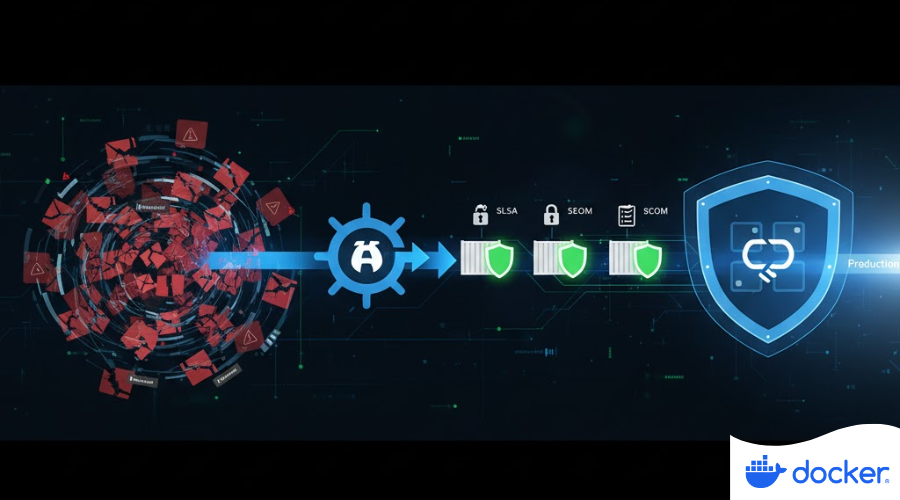
Docker is simplifying Kubernetes security! Discover how new Helm charts in the Docker Hardened Images (DHI) Catalog give users a secure, compliance-ready alternative after the Broadcom/Bitnami changes. Deploy DHI by default, ensuring SLSA Level 3 security and SLA-backed patching for every Kubernetes workload.

Docker’s Hardened Images (DHI) are secured by a dual approach: human expertise backed by AI. Discover how Docker’s internal AI guardrail spotted a critical logic flaw in an nginx-exporter update, blocked the release, and contributed the fix upstream, proving AI is the best force multiplier for security architects

Choosing the right Kubernetes architecture is no longer about picking a single environment. From cloud and edge to hybrid, bare-metal, and multicloud setups, each option offers unique benefits and challenges. This article by Ben Radstone explores six key Kubernetes deployment models, comparing their pros, cons, and ideal use cases to help organizations design flexible, resilient, and cost-efficient infrastructures for modern workloads.

Managed Kubernetes services like AKS may simplify cluster deployment, but they still leave you managing complex infrastructure tasks. This article explores how Spectro Cloud Palette streamlines Azure Kubernetes Service operations—automating configuration, scaling, monitoring, and security—so you can enjoy the benefits of AKS without the operational headaches.